
6 months · Full-time · Online & offline
Forward Deployed
Engineer
Learn to build software and AI solutions
that solve real business problems.
Get details about the course, batches and learning formats.
- Hands-on projects
- Weekly code reviews
- Daily communication training

What a Forward Deployed Engineer Does
An engineer who works directly with a business, understands its real operational problems, and builds and deploys the software and AI that solves it. Not just a coder: a problem solver who knows the customer's industry.
Discover
Interview stakeholders, observe frontline work, identify bottlenecks, and quantify the real business problem before writing any code.
Map
Capture operational workflows, data handoffs, edge cases, and legacy systems to define a high-leverage, prioritized MVP.
Build & Integrate
Ship full-stack web, mobile, and applied AI systems that connect to real enterprise data with strict security and reliability.
Adopt & Operate
Lead user acceptance testing (UAT), training, production monitoring, rollback runbooks, and measurable business-value delivery.
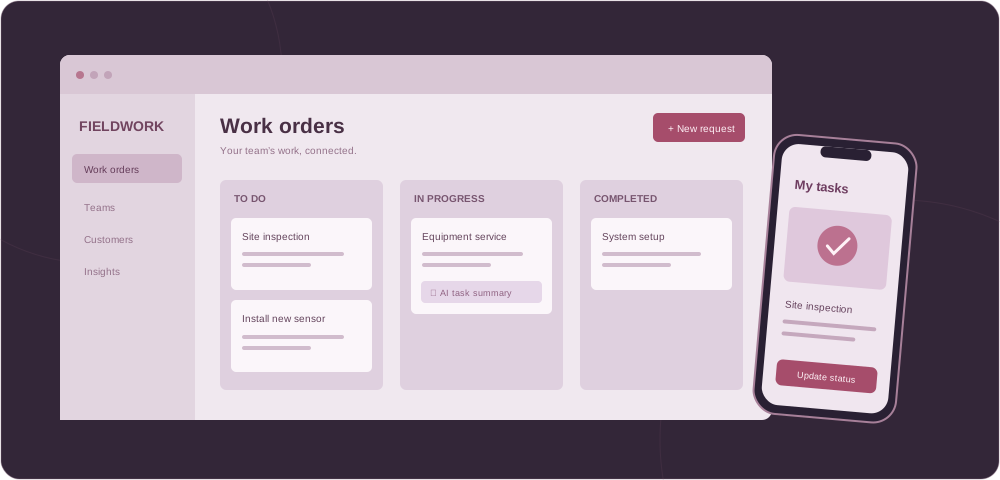
One Enterprise Platform, Enhanced Module by Module
Every assignment extends a single enterprise work-order and field-service platform. Build the interface, data layer, mobile workflows, and AI capabilities into one cumulative engineering portfolio.
The 24-Module Engineering Roadmap
Six progressive stages taking you from core programming foundations to enterprise multi-tenant AI systems deployed on AWS.
 Stage A · Modules 1–3
Web and Programming Foundations
3 modules +
Web and Programming Foundations
HTML5, CSS3, Python 3.12+, Pytest
- Mod 01: HTML, CSS & Responsive Web Foundations (Flexbox, Grid, Dashboard UI)
- Mod 02: Python Fundamentals (Core types, control flow, functions, PEP 8)
- Mod 03: Problem Solving with Python (Decomposition, sorting, Big-O, pytest)
Stage B · Modules 4–8
FastAPI and Database Engineering
5 modules +
FastAPI and Database Engineering
FastAPI, PostgreSQL 16+, SQLAlchemy 2.x, Alembic
- Mod 04: Backend API Development with FastAPI
- Mod 05: Relational Database Fundamentals (ERDs, Normalization, ACID)
- Mod 06: PostgreSQL Database Engineering (Indexes, JSONB, EXPLAIN ANALYZE)
- Mod 07: Database Transactions, Concurrency, Isolation Levels & Safe Migrations
- Mod 08: ORM with SQLAlchemy 2.x (Relationships, Eager Loading, Pooling)
Stage C · Modules 9–13
JavaScript, TypeScript, React and Hardening
5 modules +
JavaScript, TypeScript, React and Hardening
React, TypeScript 5.x, TanStack Query, Vitest, OWASP
- Mod 09: Modern JavaScript ES2022+ (Closures, async/await, event loop)
- Mod 10: TypeScript for Applications (Strict typing, generics, Zod validation)
- Mod 11: React Fundamentals (Components, hooks, controlled forms, testing)
- Mod 12: Advanced React (State machines, TanStack Query caching, route auth)
- Mod 13: Testing & Security Hardening (OWASP Top 10, RBAC, Playwright, CI)
Stage D · Modules 14–15
Customer Discovery and Mobile Field Delivery
2 modules +
Customer Discovery and Mobile Field Delivery
Miro, Jira, React Native, Expo, Offline Sync
- Mod 14: Customer Discovery & Process Analysis (Stakeholder mapping, MVP specs)
- Mod 15: Mobile Application Delivery (React Native Expo, camera, offline drafts)
 Stage E · Modules 16–20
LLMs, Retrieval, Tools, MCP and Agents
5 modules +
LLMs, Retrieval, Tools, MCP and Agents
pgvector, RAG, Model Context Protocol (MCP), LangGraph
- Mod 16: LLM Integration & AI Fundamentals (Structured output, streaming, costs)
- Mod 17: Embeddings, Vector Search & Hybrid Retrieval (pgvector HNSW, FTS)
- Mod 18: RAG Architecture & Evaluation (Source citations, Ragas, faithfulness)
- Mod 19: Tool Calling, MCP & Enterprise Integration (Tool schemas, ERP APIs)
- Mod 20: Agent Workflows & Orchestration (Plan-act-observe, human gates, safety)
Stage F · Modules 21–24
Enterprise AI Architecture, AWS Delivery & Capstone
4 modules +
Enterprise AI Architecture, AWS Delivery & Capstone
Docker, GitHub Actions, AWS EC2, RDS, S3, Capstone
- Mod 21: Enterprise AI Architecture & LLMOps (Multi-tenancy, prompt versioning)
- Mod 22: DevOps, CI/CD & AWS Cloud Deployment (Docker, private RDS, CloudWatch)
- Mod 23: Requirements, Technical Design, UAT & Customer Handover
- Mod 24: Enterprise AI Capstone Defense on Live AWS Staging
Choose your learning environment.
Discuss the available batches and practical arrangements with admissions.
Everything Included in the Program
A full-time engineering program, from foundations to a cumulative enterprise capstone.
What's Included in FDE Course
Your next engineering chapter
Build a career around
solving real problems.
Talk to admissions about the FDE roadmap, upcoming batches, and learning formats.
+91 7034 395 811 ↗Let’s talk about your goals
Talk to Admissions
Frequently Asked Questions
What is a Forward Deployed Engineer?
A Forward Deployed Engineer (FDE) is a software engineer who works closely with businesses to understand their challenges and build technology solutions that solve real problems.
From identifying business needs to developing, integrating, and deploying software and AI-powered applications, an FDE helps businesses turn real-world challenges into practical technology solutions.
Do I need prior coding experience?
Not at all! You don't need any prior coding experience to join.
We'll start with the basics of HTML, CSS, and Python, then gradually move into database engineering, full-stack development with React, and advanced AI applications.
The course is designed to help you build your skills from scratch, even if you're completely new to coding.
What are the class timings and schedule?
The course runs Monday to Friday, with 6–8 hours of learning and practice each day.
You'll spend your days building real-world projects, improving your skills through weekly mentor-led code reviews, and developing your communication skills with a dedicated 1-hour training session every day.
What certifications will I receive after completing the course?
You’ll have the opportunity to earn two certificates!
Once you’ve successfully completed your weekly assessments and capstone project, you’ll need to pass the final Take Off Interview (TOI) to receive your Brototype Course Completion Certificate.
To earn your NCVET Certificate, you’ll also need to take and pass a separate exam conducted by an NCVET-approved body.